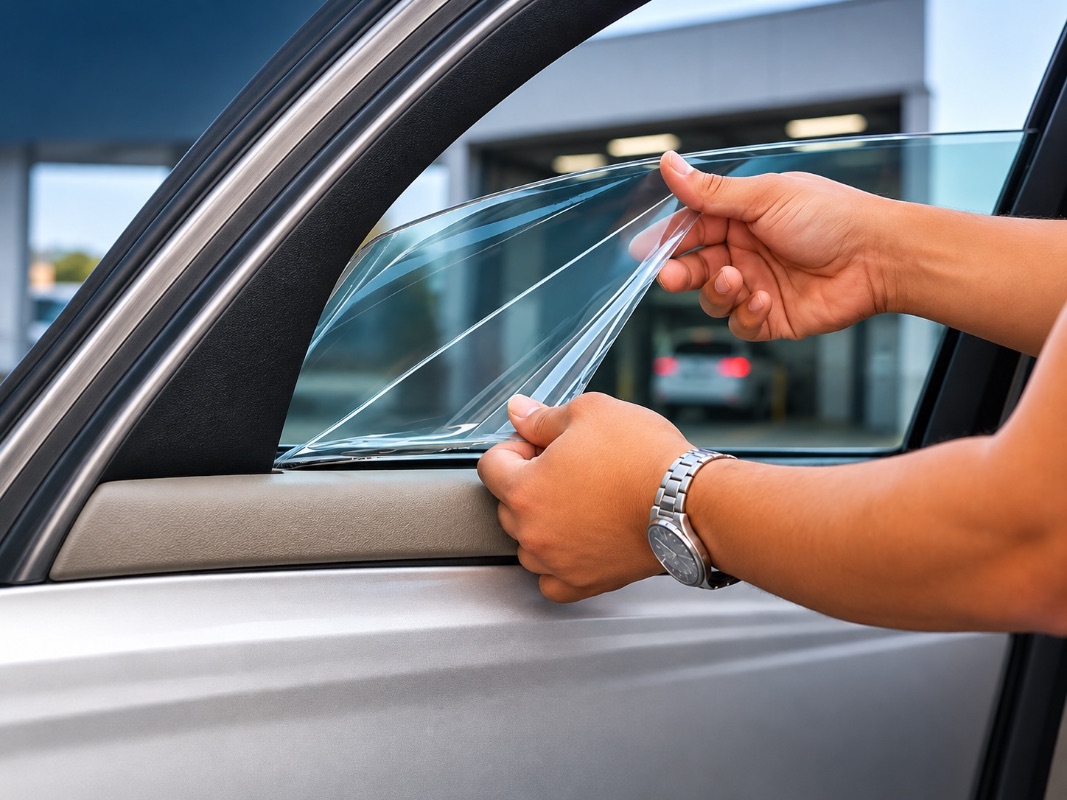
Tinted windows are one of the most popular choices among drivers looking to enhance their car's appearance, reduce interior temperatures and protect themselves from solar radiation. However, alongside the aesthetic and practical benefits of window tinting films, there is an important issue to consider: their legality and the requirements they must meet during the Greek vehicle roadworthiness inspection (KTEO).
Can a car with very dark windows pass its KTEO inspection? Is a certificate required for window tinting films? What happens if a driver has tinted windows but does not have the necessary documentation?
The answer is that tinted windows are permitted in Greece, but only under specific conditions. Most importantly, having window films professionally installed is not enough. All applicable legal requirements must also be met.
How Dark Can Your Car's Tinted Windows Be?
The main legislation governing solar-control window films in Greece is Joint Ministerial Decision 29039/2123/07/2008 (Government Gazette 1069/B/10-6-2008).
It establishes specific minimum visible light transmission (VLT) requirements depending on the position of each window.
The permitted limits are as follows:
Front windscreen: Minimum light transmission of 75%.
Front side windows: Minimum light transmission of 70%.
Rear side windows and rear windscreen: If the vehicle does not have exterior rear-view mirrors, a minimum light transmission of 70% applies.
Rear windows with exterior rear-view mirrors: There is no minimum light transmission requirement.
There is an important detail that many drivers overlook: these percentages do not refer exclusively to the window film itself, but to the combined light transmission of the original glass and the applied film.
For example, if a car already has slightly tinted factory-installed windows, adding another film can further reduce the amount of light passing through the glass. Therefore, even a relatively light-coloured film may result in an illegal level of light transmission when applied to the front windows.
Which Window Films Are Prohibited?
Greek legislation does not only regulate visible light transmission. It also establishes specific restrictions regarding the type and installation of window films.
In particular:
1. Mirror-effect window films
Mirror-effect films are prohibited on all vehicle windows. Films with a light reflectance coefficient greater than 25% fall into this category.
2. Films on the windscreen
A film that reduces the windscreen's total light transmission below 75% is not permitted. However, a special anti-glare strip is allowed along the upper part of the windscreen, with a maximum width of 10 centimetres.
3. Covering the third brake light
If the vehicle has a third brake light installed on the rear window, its illuminated surface must not be covered by the film.
4. Non-certified window films
Window films must be certified for installation and use in vehicles by the relevant competent authorities. Choosing an inexpensive film without the required certification details may create problems both during the vehicle inspection and in the event of a traffic police check.
What Documents Are Required for Tinted Windows at KTEO?
This is perhaps the most important point every car owner should know.
The installation of solar-control window films must be accompanied by the required documentation. Drivers should not simply collect their vehicle after installation; they should also make sure they receive all relevant certificates and documents.
Specifically, the following are required:
The original window film installation certificate, properly completed and signed.
The certification details of the film.
The prescribed certification sticker, installed in accordance with the applicable legislation.
The installation certificate must include all required information, such as the film type, certificate number, issuing authority and installation details.
Therefore, before leaving the workshop where the installation was carried out, drivers should check that they have received all the necessary documentation.
What Exactly Does KTEO Check Regarding Tinted Windows?
During the periodic roadworthiness inspection, tinted windows do not go unnoticed. The inspector checks whether the installation complies with the applicable legal requirements.
In practice, the inspection includes:
Compliance with the legal visible light transmission limits.
The presence of the required installation certificate.
The correct completion of the certificate details.
The presence of the certification marking and whether it matches the information provided in the documents.
The presence of the required exterior rear-view mirrors, where applicable.
The condition of the window films and whether they affect the driver's visibility.
In other words, it is not enough for a window film to look properly installed. It must be legal, certified and accompanied by the required documentation.
When Can a Car Fail Its KTEO Inspection Because of Tinted Windows?
Not every car with tinted windows is automatically at risk of failing its roadworthiness inspection. However, there are specific situations in which a major defect may be recorded.
These include:
Failure to comply with the legal restrictions on window film installation.
Absence of the required installation certificate.
Incorrect or incomplete information on the certificate.
Use of non-certified window films.
Absence of the prescribed certification sticker or a mismatch with the certification details.
Absence of the required exterior rear-view mirrors where these are a legal requirement.
Significant deterioration of the film when it creates visibility problems.
Particular attention should be paid to bubbles, severe cloudiness, yellowing, image distortion, swelling and peeling.
If these defects are significant and affect the driver's visibility, they may be classified as a major defect.
What does this mean for the driver? If a major defect is recorded, the vehicle will not successfully complete the inspection. The problem must be rectified and the vehicle must undergo the prescribed reinspection procedure.
What If the Car Has Factory-Tinted Windows?
Many manufacturers offer vehicles with factory-tinted glass, particularly on the rear windows.
However, these windows are not treated in exactly the same way as aftermarket adhesive window films.
Greek legislation provides a specific exemption from the light transmission restrictions for glass marked with the letter "V".
Therefore, if a vehicle has factory-tinted windows, the owner should not automatically assume that an aftermarket window film installation certificate is required. It is necessary to establish what type of glass the vehicle has and whether additional films have been applied.
Is There an Exemption for Medical Reasons?
Yes. Greek legislation provides for a special possibility of using window films in cases where drivers or passengers have medical conditions requiring increased protection from solar radiation.
This exemption is not granted automatically simply by presenting a medical certificate. The required medical documentation and approval from the competent authorities must be obtained, in accordance with the applicable procedure.
How to Avoid Problems During Your Next KTEO Inspection
If you are considering installing tinted windows or already have them fitted to your vehicle, there are a few simple steps that can help you avoid unpleasant surprises:
Choose a professional installer who uses certified window films.
Request the original installation certificate.
Make sure the required certification marking is present on the windows.
Check that the front windows meet the legal light transmission limits, taking both the glass and the film into account.
Do not cover the third brake light.
Regularly inspect the films for bubbles, swelling and peeling.
If your car already has tinted windows and you are unsure whether they comply with the law, you can contact a specialised installer or a KTEO inspection centre for information about the requirements and the necessary checks.
Conclusion: Tinted Windows Can Pass KTEO, But Not All of Them!
Tinted windows are not prohibited in Greece. On the contrary, they are a perfectly legal option, provided that all applicable legal requirements are met.
The most important thing every driver should remember is that purchasing a certified film is not enough. Proper installation, compliance with the light transmission limits, the required certification marking and the relevant installation certificate are all essential.
During a KTEO inspection, missing documentation or the use of non-compliant window films may result in a major defect and the need for a reinspection.
Therefore, before installing tinted windows on your car, make sure you are properly informed. This way, you can enjoy the protection and appearance offered by solar-control window films without facing unpleasant surprises at your next vehicle inspection.
Sources – Useful Information
For more information about the legality of solar-control window films, the required documentation and KTEO vehicle inspections, you can consult the following sources.
eKTEO Help Centre
Relevant Legislation and Regulations
The above links are provided for informational purposes. The applicable legislation, including any subsequent amendments and the latest published Government Gazette provisions, should always be consulted.