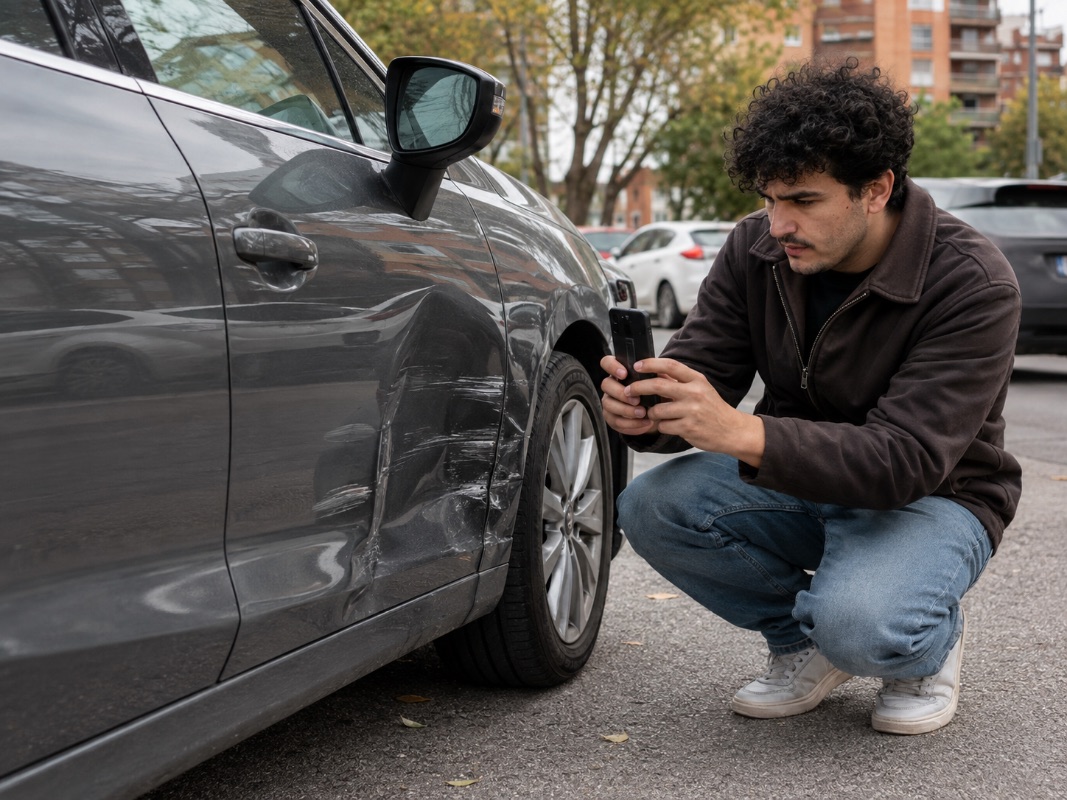
Accident with an Expired KTEO: Who Pays and What Happens with Your Insurance?
Your KTEO has expired and you are involved in a road accident. Do you lose your right to compensation? Can your insurance company refuse to pay? Are you automatically considered at fault? And what fine can the Police impose?
This is one of the issues that causes the most confusion among drivers.
The short answer is:
Having an expired KTEO is a traffic violation, but it does not automatically mean that you are responsible for an accident or that your compulsory motor insurance stops covering you.
Let’s look at what actually happens in each case.
I Had an Accident and My KTEO Has Expired. What Happens?
First, we need to separate two different issues:
Who is responsible for the accident?
and
Was the vehicle being driven without a valid technical inspection?
The second is a violation of the Greek Road Traffic Code.
However, it does not automatically answer the first question.
In simple terms:
Expired KTEO ≠ automatic liability for an accident.
To determine who caused an accident, the actual circumstances are examined: the vehicles’ movements, speed, right of way, manoeuvres, road conditions and — where relevant — the technical condition of the vehicles.
This distinction is important and is also reflected in recent case law.
In a case examined by the Greek Supreme Court (Areios Pagos, Decision 13/2025), the vehicle’s Technical Inspection Certificate had expired two months before the accident. The Court held that merely referring to the expired inspection was not sufficient. It had to be explained how specific technical defects could have contributed to the loss of control and the accident.
Source: Greek Supreme Court, Decision 13/2025.
Scenario 1: The Accident Was Not My Fault
Let’s take a simple example.
Your KTEO has expired, but you are correctly stopped at a red traffic light and another vehicle crashes into the back of your car.
The fact that your vehicle did not have a valid KTEO does not automatically mean that you lose your right to compensation or that you become responsible for the collision.
The accident is assessed according to how it actually happened.
An expired KTEO is a separate traffic violation and may carry its own administrative penalties, but it does not automatically turn a driver who did not cause the accident into the responsible party.
However, if it is proven that a serious technical defect in your vehicle actually contributed to the accident or increased the resulting damage, the technical condition of the vehicle may be taken into account when determining liability.
So the key question is not simply whether the vehicle had a valid KTEO.
The important question is:
Was there a technical problem, and did it contribute to the accident?
Source: Greek Supreme Court 13/2025, regarding the need to establish a connection between the vehicle’s technical condition and the accident.
Scenario 2: I Caused the Accident and My KTEO Has Expired
This is where the biggest question usually arises:
Will My Insurance Company Pay the Other Driver?
Under compulsory motor third-party liability insurance, Greek law provides for specific grounds on which insurance coverage may be excluded.
The main statutory exclusions relate to:
driving without the required driving licence,
driving under the influence of alcohol or toxic substances under the conditions provided by law,
using the vehicle for a purpose different from that stated in its registration documents and insurance policy, where the required causal connection exists.
An expired KTEO is not included in this list.
Article 6b of Presidential Decree 237/1986 also provides that additional exclusions may only be agreed for optional insurance coverage.
Any additional exclusion from compulsory motor third-party liability coverage outside those provided by law is invalid.
Therefore:
The absence of a valid KTEO does not, by itself, cancel compulsory motor third-party liability insurance.
The injured third party remains protected under the compulsory insurance system, and the insurance company is not automatically released from its obligation towards the third party simply because the insured vehicle had an expired KTEO.
Sources: Presidential Decree 237/1986, Article 6b, and Piraeus Court of Appeal Decision 60/2026.
What About Damage to My Own Car?
This is where an important distinction needs to be made.
Compulsory third-party liability insurance is different from optional insurance cover, such as comprehensive insurance or own-damage cover.
For optional insurance benefits, insurance companies may legally include additional terms and exclusions in the policy.
Therefore:
If you have comprehensive insurance and cause an accident while your KTEO has expired, the terms of your specific insurance policy must be checked.
There is no single answer that applies to every insurance company and every policy.
This is different from compulsory third-party liability insurance.
Source: Presidential Decree 237/1986, Article 6b(2), regarding additional exclusions in optional insurance coverage.
What If the Accident Was Caused by a Technical Defect?
This is where the technical inspection becomes particularly important.
Imagine a vehicle that has not undergone its required KTEO inspection and has a serious braking-system defect.
The driver tries to brake, but the vehicle fails to slow down properly and causes a collision.
If it is proven that the technical defect contributed to the accident, then the condition of the vehicle may become an important factor when liability is assessed.
This is very different from simply saying:
“The vehicle did not have a valid KTEO, therefore the driver was at fault.”
The correct question is:
“Did the technical condition of the vehicle contribute to the accident?”
In Supreme Court Decision 13/2025, the Court specifically required adequate reasoning as to how the identified technical defects and the delayed KTEO inspection could have contributed to the loss of control of the vehicle.
Source: Greek Supreme Court, Decision 13/2025.
Can the Police Fine Me If They Discover That My KTEO Has Expired?
Yes. This is a separate violation.
Even if you were not responsible for the accident, if the Police establish that the vehicle was being driven without the required periodic technical inspection, the penalties provided by the Greek Road Traffic Code apply.
For a standard private passenger vehicle, the offence falls under category E2-B.
The penalty is:
€150 administrative fine
and
suspension of the driving licence for 20 days.
The driving-licence suspension applies to the driver, while the financial penalty is imposed on the owner of the vehicle.
Sources: Law 5209/2025, Articles 90 and 108.
Can the Fine Be Reduced?
Yes, for standard private vehicles there is a specific provision.
If you take the vehicle for a KTEO inspection and submit a valid Technical Inspection Certificate within 10 days to the authority that imposed the fine, the Greek Road Traffic Code provides for payment of:
€45
instead of the standard fine, where the relevant conditions are met.
Documents that were removed may also be returned in accordance with the conditions set out in the law.
This reduced-fine provision does not apply to certain vehicle categories excluded by the Road Traffic Code, such as taxis, ambulances, buses and trucks weighing more than 3.5 tonnes.
Source: Law 5209/2025, Article 107.
So What Actually Happens If I Have an Accident Without a Valid KTEO?
SituationWhat appliesThe accident was not your faultYou do not automatically lose your right to compensation because your KTEO has expiredYou caused the accidentAn expired KTEO alone does not cancel compulsory third-party liability coverageYou have comprehensive insuranceThe terms and exclusions of the optional insurance policy must be checkedA technical defect contributed to the accidentIt may significantly affect the assessment of liabilityPolice discover an expired KTEO on a standard private car€150 fine + 20-day driving-licence suspensionYou pass the KTEO inspection and submit the certificate within 10 daysThe fine may be reduced to €45, where applicable
Can an Expired KTEO Be Detected Without a Police Stop?
Yes.
Greece now operates a system of electronic cross-checks for vehicles, using data from government databases to identify non-compliance with various legal obligations, including periodic KTEO inspections.
This means that a roadside Police check is not necessarily required for authorities to identify a vehicle that has not undergone its required technical inspection.
Source: Joint Ministerial Decision 175625 EX 2025, as amended, and the General Secretariat for Information Systems and Digital Governance.
How Often Does a Car Need a KTEO Inspection?
For a standard private passenger car:
First KTEO inspection
4 years after the vehicle’s first registration.
After that
Every 2 years.
For taxis, ambulances, buses and certain categories of heavy vehicles, the first periodic technical inspection takes place one year after the first registration and then every year.
Source: Joint Ministerial Decision 49372/3352/2017, Article 6.
Don’t Remember When Your Next KTEO Is Due?
You do not need to rely on memory.
With eKTEO, you can enter your vehicle details, check when your next technical inspection is due and activate a free reminder.
👉 Check when your next KTEO is due & activate a free reminder
What Should You Remember If You Are Involved in an Accident?
First, make sure everyone involved is safe and contact the relevant authorities where necessary.
Record the details of the vehicles and drivers, take photographs of the scene and the damage, and notify your insurance company as soon as possible.
If you discover that your KTEO has expired, do not automatically assume that this means you caused the accident or that you have no insurance coverage.
At the same time, do not ignore the expired inspection.
Arrange the required technical inspection as soon as possible, particularly because the Road Traffic Code provides a specific 10-day period during which a reduced fine may apply after the violation has been recorded, where the legal conditions are met.
The Bottom Line
The most important thing for drivers to understand is:
An expired KTEO is a traffic violation. However, by itself, it does not prove that you caused an accident and does not automatically cancel your compulsory motor insurance.
If an accident occurs, authorities and insurers examine what actually happened and whether the technical condition of the vehicle had any connection with the accident.
The KTEO violation itself is dealt with separately under the Greek Road Traffic Code.
That is why the simplest solution is to:
know when your KTEO expires and avoid leaving your inspection until the last minute.
Make Your Next KTEO Easier
If your inspection date is approaching, you can use eKTEO to choose a participating inspection centre and book your KTEO appointment online, with immediate confirmation and no additional fee charged by the platform.
👉 Book your KTEO appointment online
If your next inspection is still some time away:
👉 Enter your details & activate a free KTEO reminder
The eKTEO reminder service is free and available to everyone.
Its purpose is simple: to make the process easier and help every driver know in advance when their next technical inspection is due.
Sources & Legislation
Law 5209/2025 – Greek Road Traffic Code, Articles 90, 107 and 108, as subsequently amended.
Presidential Decree 237/1986 / Law 489/1976 – Compulsory Motor Third-Party Liability Insurance, Article 6b.
Greek Supreme Court Decision 13/2025, regarding the need for a causal connection between the technical condition of the vehicle and the accident.
Piraeus Court of Appeal Decision 60/2026, regarding the limited statutory exclusions from compulsory motor insurance coverage.
Joint Ministerial Decision 49372/3352/2017, Article 6 – frequency of periodic KTEO inspections.
Joint Ministerial Decision 175625 EX 2025, as amended – electronic vehicle compliance cross-checks.
This article is provided for general information and reflects the legal framework and sources reviewed up to August 2026. In any specific insurance dispute or court case, the individual circumstances and the terms of the relevant insurance policy must always be examined.